
How Can I Rank My Website on Google?
How Can I Rank My Website on Google?
If you’re asking, “How can I rank my website on Google?”, you’re not alone. Every website owner wants to appear on the first page of Google — especially in competitive countries like the US and India.
The truth is simple: ranking on Google is not magic. It’s a process. If you follow the right SEO steps consistently, even a new website can start ranking within a few months.
In this step-by-step guide, I’ll show you exactly how to rank your website on Google in 2026.
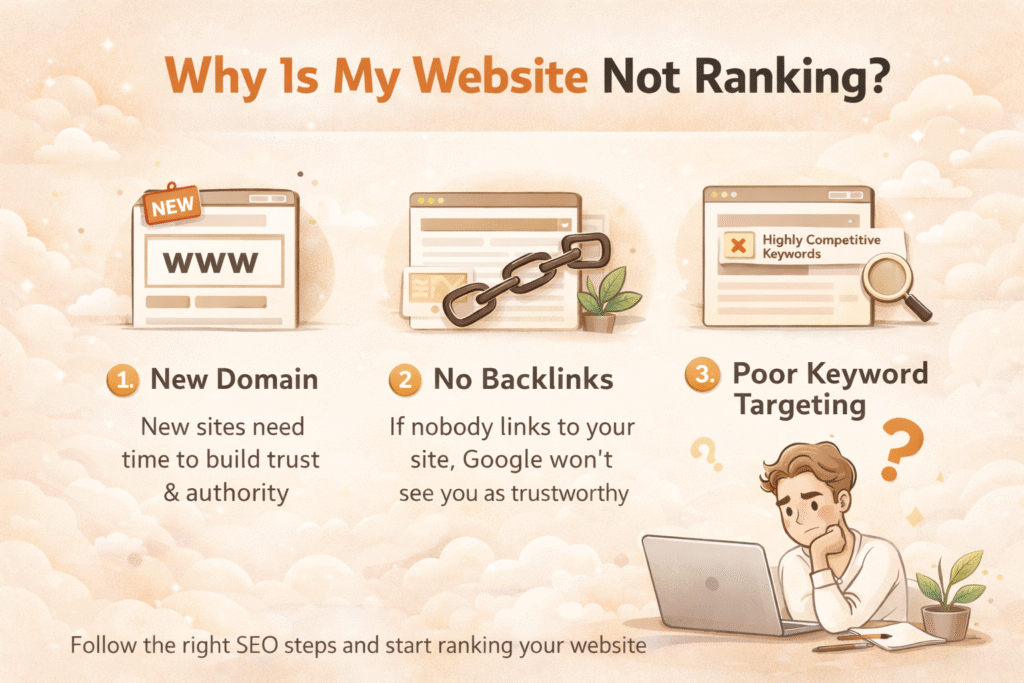
Why Is My Website Not Ranking?
Before learning how to rank your website, you need to understand why it’s not ranking.
Here are the most common reasons:
1. New Domain
If your website is new (less than 6 months old), Google is still evaluating it. New domains need time to build trust and authority.
2. No Backlinks
Backlinks act like votes. If no other websites link to yours, Google may not see your site as trustworthy.
3. Poor Keyword Targeting
Many websites try to rank for high-competition keywords like “digital marketing” or “SEO services.” These are extremely competitive.
Instead, you should target long-tail keywords like:
- how can I rank my website
- how to rank a new website on Google
4. Thin Content
Short, low-value content (300–500 words) usually does not rank. Google prefers detailed, helpful content.
5. No Internal Linking
If your blog posts are not connected to each other, Google cannot properly understand your website structure.
Now let’s fix all of this.
Step 1 – Choose the Right Keywords
Keyword research is the foundation of ranking.
If you choose the wrong keyword, even perfect content won’t rank.
Focus on Long-Tail Keywords
Instead of targeting:
❌ “SEO”
Target:
✅ “SEO tips for new website”
✅ “how can I rank my website”
Long-tail keywords:
- Have lower competition
- Are easier to rank
- Bring targeted traffic
Choose Low Competition
If your site is new, always select keywords with:
- 10–100 monthly searches
- Low competition
Ranking for 10 small keywords is better than failing for one big keyword.
Use Google Keyword Planner
Search variations like:
- how can I rank my website
- how to rank a new website on Google
- why is my website not ranking
Check:
- Location: US + India
- Language: English
- Competition: Low
This is the smartest way to grow traffic.
Step 2 – Optimize Your Content Properly
Now that you have your keyword, you must optimize your blog correctly.
Place the Keyword Strategically
Use your main keyword:
- In the title
- In the first 100 words
- In H2 headings
- In the URL
- Naturally inside content
For example:
Title:
How Can I Rank My Website on Google in 2026?
URL:
how-can-i-rank-my-website
Do NOT stuff keywords. Use them naturally.
Add Related Keywords
Google understands context. Add related phrases like:
- rank website on Google fast
- SEO tips for new website
- how long does it take to rank on Google
This improves topic authority.
Write High-Quality Content
Google ranks helpful content.
Make sure your blog:
- Is at least 1200 words
- Solves real problems
- Uses simple language
- Includes headings and subheadings
Long, structured content ranks better than short content.
Step 3 – Improve Technical SEO
Even great content won’t rank if your website is technically weak.
Here’s what you must check:
Fast Loading Speed
Your website should load in under 3 seconds.
Use compressed images and lightweight themes.
Mobile Friendly
More than 60% of traffic comes from mobile devices.
Your site must look good on phones.
SSL (HTTPS)
If your website does not have HTTPS, Google may reduce trust.
Sitemap Submission
Submit your XML sitemap in Google Search Console.
This helps Google discover your pages faster.
Technical SEO builds trust with search engines.
Step 4 – Build Quality Backlinks
Backlinks are one of the strongest ranking factors.
If you’re wondering how to rank your website faster, backlinks are the answer.
Guest Posting
Write articles for other blogs in your niche and include a link back to your website.
Directory Submissions
Submit your site to relevant, high-quality directories.
Social Sharing
Share your blogs on:
Social signals can increase visibility.
Internal Linking
Link your new blog to older blogs and service pages.
Example:
If you wrote a blog about keyword research, link it from this article.
This improves:
- User experience
- Crawlability
- SEO performance
Focus on quality, not quantity.
Step 5 – Be Consistent (This Is Important)
Many website owners quit too early.
Ranking does not happen overnight.
Post 2 Blogs Per Week
Consistency signals authority to Google.
Update Old Content
Refresh outdated posts:
- Add new data
- Improve structure
- Add internal links
Updated content often ranks faster.
Track Performance in Search Console
Check:
- Impressions
- Clicks
- Keyword rankings
If a page gets impressions but no clicks, improve the title and meta description.
SEO is a long-term game.
How Long Does It Take to Rank?
If you’re asking, “How long does it take to rank on Google?” — here’s the realistic answer:
- New website: 3–6 months
- Low competition keywords: 2–4 months
- High competition keywords: 6–12+ months
Ranking depends on:
- Competition
- Content quality
- Backlinks
- Consistency
Be patient. The results compound over time.
Final Tips to Rank Faster
Here are proven tips to improve rankings:
Answer Real Questions
Write blogs based on actual search queries.
Focus on Search Intent
If someone searches “how can I rank my website,” they want steps — not theory.
Write in Simple Language
Clear content performs better than complicated content.
Add FAQ Section
Example FAQs:
Q1: Why is my website not ranking on Google?
Because of poor keyword targeting, lack of backlinks, or thin content.
Q2: Can a new website rank on Google?
Yes, by targeting low-competition long-tail keywords.
Q3: How many backlinks do I need to rank?
Quality matters more than quantity.
Conclusion
If you truly want to know how to rank your website on Google, remember this:
- Choose low-competition keywords
- Optimize content properly
- Improve technical SEO
- Build backlinks
- Stay consistent
SEO is not instant, but it is powerful.
Start with small, achievable keywords. Build authority slowly. Within months, you’ll see growth in traffic and rankings.
If you follow these steps carefully, your website can begin ranking — even in competitive markets like the US and India.